Why Version Control Exists: The Pendrive Problem
Understanding the real pain before Git
Before learning any tool, I strongly believe one thing:
first understand the problem, then the solution automatically makes sense.
So instead of starting with Git commands, let’s talk about how developers used to work before version control existed.
Once you see that pain clearly, you’ll understand why version control is no longer optional.
Life before version control systems
Before Git and GitHub, developers still had to work together.
But the methods were very manual, risky, and confusing.
The email workflow
How it worked
Developer A writes code
Compresses the project into a ZIP file
Emails it to Developer B
Developer B makes changes and emails it back
This cycle repeats again and again
Problems with this approach
Version confusion
Files were named like:final.zip
final_real.zip
pakkafinal.zip
Human errors
Someone sends the wrong ZIP fileNo rollback
If the new code breaks something, there’s no safe way to go back
Slowly, inboxes filled with ZIP files but clarity was still missing.
Shared folders on network devices
When emails became chaotic, teams moved to shared folders.
How it worked
Project is stored in a shared folder
Developers download it locally
Create backups like:
project_backupbackup_final
Upload it again, overwriting previous code
Problems here
Someone accidentally overwrites working code
No version history
Small conflicts go unnoticed
One mistake can break everything
This worked for very small teams, but not for long.
The pendrive workflow (the real nightmare)
Now comes the most famous one — the pendrive method.
Imagine three friends: Aman, Abhi, and Ravi working on one project.
How the pendrive story goes
Aman starts the project and writes HTML and CSS
He copies the folder into a pendrive and gives it to Ravi
Ravi adds JavaScript and UI improvements
He also edits some of Aman’s files
Saves everything and gives the pendrive to Abhi
Abhi adds backend logic
Accidentally removes some JavaScript code
The site still runs, so he doesn’t notice
Saves and returns the pendrive
A few days later, Aman opens the project.
Something feels wrong.
One feature that worked earlier is now broken.
Now the confusion starts
Everyone starts asking:
Who changed this file?
When did this bug come?
Which version was actually working?
No one knows.
So people start creating folders:
project_finalproject_final_v2project_final_lastreally_final
Laptops get filled with folders, but clarity is still zero.
And one more scary question:
What if the pendrive gets lost or damaged?
All the hard work is gone.
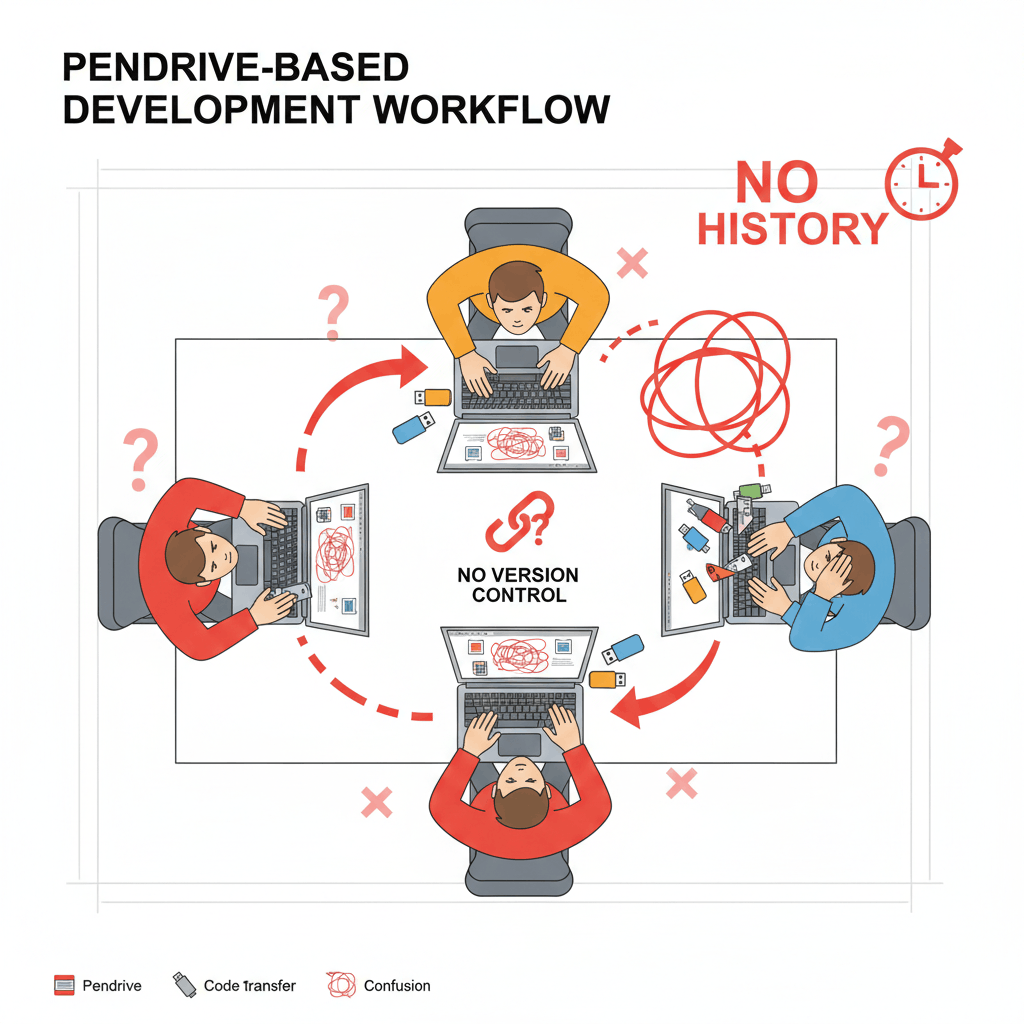
Problems faced before version control systems
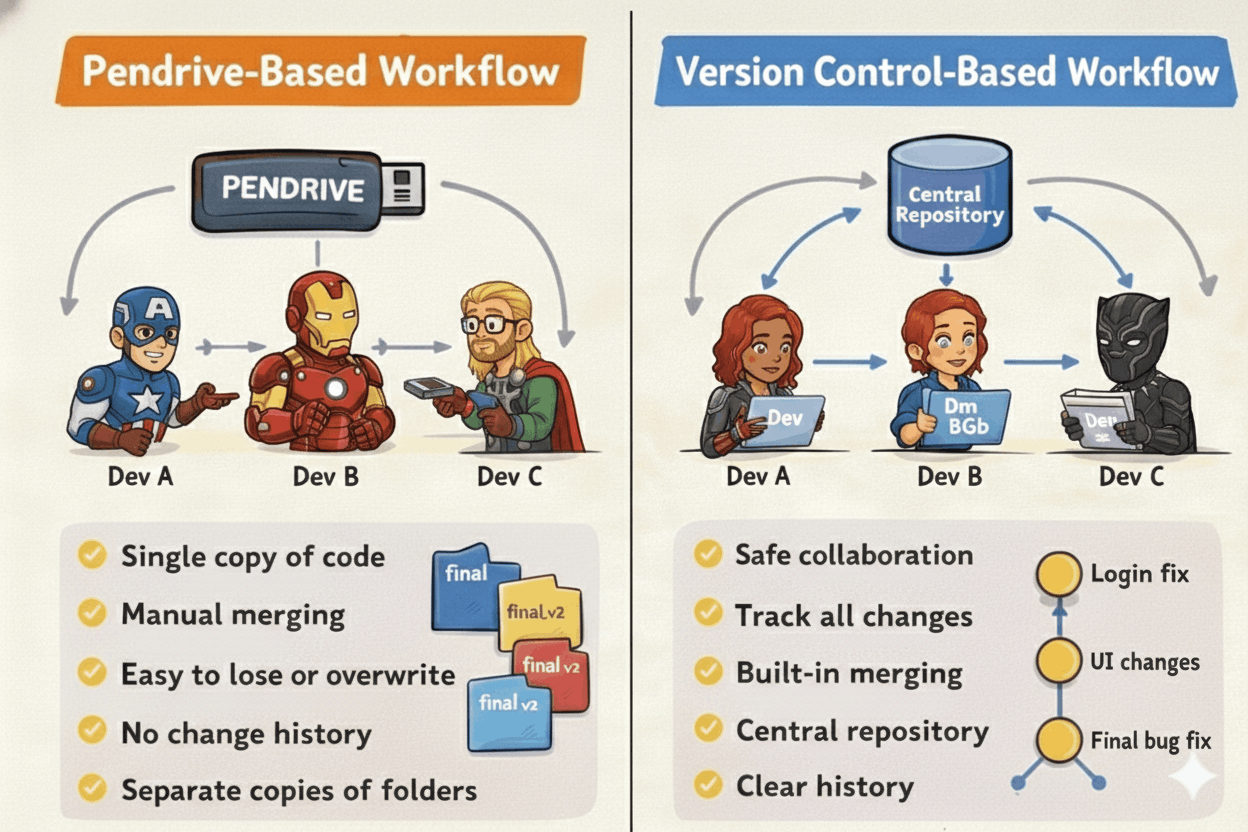
From all these workflows, the same problems kept repeating:
No single source of truth
No history of changes
No idea who changed what
Easy to overwrite someone else’s work
Difficult to fix bugs
Zero support for remote collaboration
Scaling to more developers became impossible
Development became more about managing chaos than writing code.
Why version control became mandatory
As software grew bigger and teams became global, these old methods completely failed.
Modern development needs:
Multiple developers working at the same time
Safe rollback when something breaks
Clear history of changes
Collaboration without overwriting work
Today:
CI/CD pipelines depend on version control
Open source projects cannot exist without it
Platforms like GitHub are built on it
Large teams are impossible to manage without it
Version control solved all the problems that pendrives, emails, and shared folders couldn’t.
Final thoughts
Version control was not invented for convenience.
It was invented because software development without it was painful and unsafe.